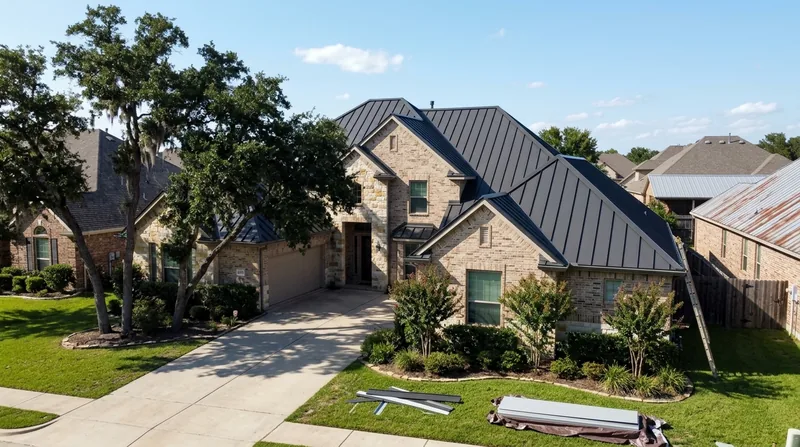




Standing Seam Metal Roofing in College Station: Built for Brazos Valley Heat, Hail, and Clay
When you need Standing Seam Metal Roofing in College Station, you want a roof that handles 100-degree summers, spring hailstorms, and the heavy black clay under every house from College Hills to Wellborn. That clay swells and shrinks with the weather, which racks the whole structure and works on every fastener in a shingle roof. Standing seam takes that movement in stride because there are no exposed screws to back out.
We roll-form panels to length on site, then mechanically seam or snap-lock them so the roof expands and contracts as one continuous skin. Homeowners in Southwood Valley, Pebble Creek, and Castlegate get a cool reflective finish that drops attic heat, plus a clean profile that suits both 1980s brick two-stories and the newer board-and-batten homes out toward Lick Creek. If you are comparing systems, start with our metal roof installation page and then come back here for the standing seam specifics.
Why Standing Seam Makes Sense on College Station Roofs
College Station sits on flat to gently rolling ground between the Brazos and Navasota rivers, and the daily sun bakes shingles until they curl and granulate away. Standing seam panels reflect that heat and stay tight through the daily expansion cycle that loosens exposed-fastener screws on cheaper systems. The same concealed fasteners hold up to the straight-line thunderstorm winds that push through the Brazos Valley every spring.
- Concealed fasteners stay put as Texas heat cycles the roof every single day.
- Panels resist hail dents and wind uplift better than exposed-screw panels.
- The reflective finish cuts attic heat load through long College Station summers.
- Panels shed oak and pecan limbs and debris without trapping water.
- Roll-formed lengths mean fewer seams and fewer places for rain to get in.
For homes under post oaks and live oaks in College Hills and Southside, that smooth surface matters as much as the finish does.
Key info: A standing seam roof on a low-pitch 1960s ranch in College Hills sheds pecan debris and summer heat far better than the original three-tab shingles, and it does it without a single exposed screw to check every spring.
Before any work starts, verify the current permit and inspection rules with the City of College Station building department, since thresholds and fees vary by jurisdiction.
How We Install Standing Seam on a College Station Home
Every job starts with a look at the deck, the pitch, and the trees overhead, because a panel roof is only as good as what it sits on. We measure on site, order panels roll-formed to the exact run lengths, and set up so the crew is not walking a fragile old deck any more than necessary. Then we work from the eaves up, flashing every penetration as we go.
- We inspect the deck and framing and replace any soft sheathing before panels go down.
- We install underlayment and ice-and-water membrane at valleys and penetrations.
- We roll-form panels to length so each run is one piece with no mid-roof lap.
- We set and fasten panels with concealed clips that allow thermal movement.
- We mechanically seam or snap-lock the panels and install ridge, hip, and edge trim.
- We flash chimneys, skylights, and vents, then walk the roof and clean the site.
On a two-story brick home in Emerald Forest, that sequence means the crew runs panels in one pass and the seams line up clean from the street.
Key info: On an acreage home near Wixon Valley with a metal shop and porch, we ran the house panels and tied the new roof into the existing barn trim so the whole place reads as one system instead of two mismatched roofs.
If your home already has shingles and you want to avoid a tear-off, read our metal roof over shingles page to see whether a retrofit fits your deck and local code.
Standing Seam Approaches We Use in the Brazos Valley
Not every College Station roof wants the same panel, and the right call depends on pitch, span, budget, and how the house sits among the oaks. Here is how the main standing seam approaches compare for local homes.
| Approach | Description | Best for |
|---|---|---|
| Mechanically seamed | Panels joined with a raised double-lock seam for maximum wind and water resistance. | Two-story homes in Southwood Valley and Castlegate facing open wind. |
| Snap-lock | Panels snap together with concealed clips and no mechanical seaming tool. | Low-pitch ranches in College Hills and Southside on tighter budgets. |
| Standing seam over existing shingles | New panels set on battens over the old roof, subject to code limits on layers. | Solid-deck homes where a full tear-off is not needed. |
| Standing seam with snow guards | Panel roof fitted with guards to control sliding ice and debris. | Steeper roofs and porches where runoff needs control. |
| Standing seam with new gutters | Panel roof paired with gutters sized for concentrated runoff. | Homes near the Navasota River bottoms with heavy storm runoff. |
We match the panel and profile to the house, the trees, and the local code, not to whatever is stacked in the yard.
Standing Seam Metal Roofing Cost in College Station: What to Expect
Standing seam pricing in College Station starts from $10 per square foot for a basic panel install, and most full homes land above that once you add trim, flashing, and the deck work older houses usually need. A low-pitch ranch in College Hills is a different job from a steep two-story in Pebble Creek, and the roof pitch alone can shift the number. Access matters too: a home tucked under live oaks or set back off Rock Prairie Road takes more staging time than a clear lot.
Panel gauge, seam type, color, and the number of penetrations all move the price. So does whether we tear off the old shingles or set panels over them, which local code limits to a set number of existing layers. Get two or three written estimates so you can compare the same scope side by side, and check our full pricing overview for the line-item detail before you call.
Standing Seam Metal Roofing Near Me: How to Pick a Contractor Near College Station
When you search for standing seam metal roofing near me, the list can look the same from one company to the next, so check the basics before anyone climbs a ladder. Ask for the license and insurance certificate, and confirm the crew doing the work is covered, not just the salesperson. Get more than one written estimate and read the scope, not just the total.
- Confirm the company is licensed and insured and can show a certificate on request.
- Ask for local references on standing seam jobs, not just shingle work.
- Check how they handle permits with the City of College Station before work starts.
- Ask about HOA or historic design review if your home sits in a regulated district.
- Get the flashing and trim scope in writing so nothing is left as an extra.
Reach out through our contact and free estimate page and we will walk your roof and put the scope in writing.
Standing Seam Metal Roofing in College Station: Pricing Guide
| Service | Price | Details |
|---|---|---|
| Standing seam panel install, basic pitch | Starting at $10/sq ft | Covers panels, concealed clips, and standard trim; steeper pitch or complex hips raise the rate. |
| Standing seam over existing shingles | Starting at $12/sq ft | Panels on battens over the old roof; added cost comes from deck prep and code layer limits. |
| Mechanically seamed premium system | Starting at $14/sq ft | Double-lock seams, heavier gauge, and upgraded underlayment; wind exposure and height push it higher. |
| Complex or large-scale roof | On estimate | Multiple valleys, dormers, or a steep two-story need an on-site look before any number is given. |
| Travel | Included | In College Station and surrounding areas, no separate call-out or mileage fee. |
| Estimate | Free | Response within 24h at (979) 200-6628, no obligation to book. |
Indicative pricing, the exact cost depends on square footage, finish, and site access. Free personalized estimate within 24h at (979) 200-6628.


